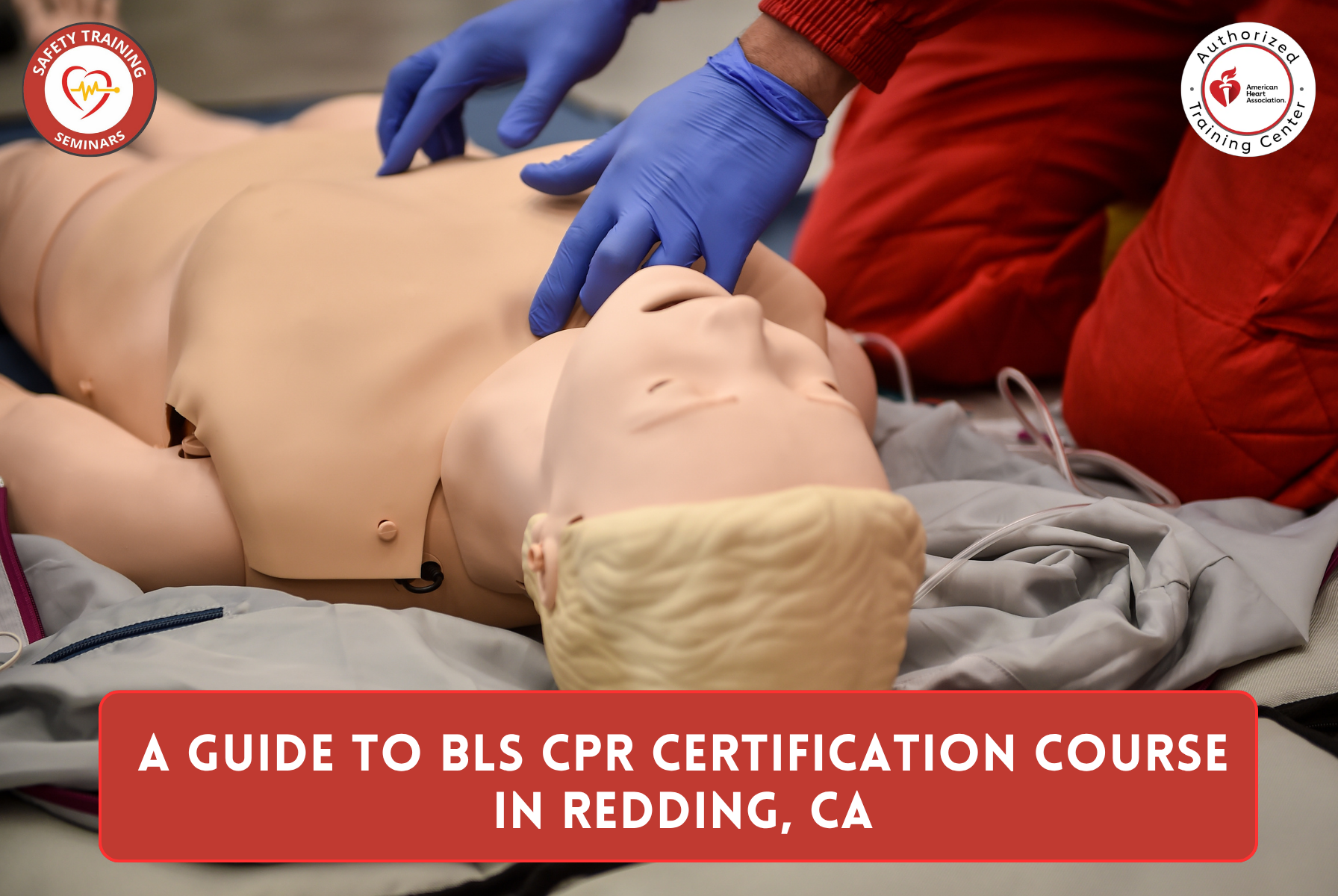
Redding has a local option for American Heart Association (AHA) PALS certification: Safety Training Seminars runs a PALS class in Redding at its Pine Street training center downtown. The PALS certification course uses a blended format. You complete the online portion first, then attend a short in-person skills session in Redding. After passing both, you receive an official AHA PALS Provider eCard, valid for two years.
That setup matters in the North State, where many healthcare workers live or work far from a major metro area. Below is an overview of who usually needs PALS in the Redding area, how the course is structured, and how to plan your certification so it takes as little time away from work and family as possible.
Redding’s Role as the North State’s Pediatric Referral Point
Redding is the main medical hub for a large, mostly rural part of California. Mercy Medical Center Redding, a Dignity Health hospital on Rosaline Avenue, reports that it serves close to 300,000 residents across six counties. The hospital describes its referral area as reaching north to the Oregon border, roughly halfway south to Sacramento, east toward Nevada, and west to the coast.
For pediatric care, that regional role carries weight. Mercy Medical Center Redding identifies itself as the only Level III neonatal intensive care unit and one of only two Level II trauma centers north of Sacramento. It also lists pediatric care, maternity services, and regional emergency care among its departments.
In practice, a seriously ill child in a small mountain town may be stabilized locally, transported by ground or air crews, and then cared for in Redding. Each provider along that path could be involved in pediatric resuscitation. Hospital pediatric nurses, emergency department staff, flight and ground paramedics, and respiratory therapists all have reasons to keep PALS current.
Some local employers state the requirement directly. A recent Mercy Medical Center Redding posting for a pediatrics registered nurse listed Pediatric Advanced Life Support among its qualifications, to be obtained within 12 months. Requirements differ by department and position, so check with your own employer.
What the PALS Course Teaches
Pediatric Advanced Life Support is an AHA program for healthcare providers who manage critically ill or injured infants and children. It builds on Basic Life Support (BLS) and adds the clinical reasoning used in pediatric emergencies.
Core content includes:
- Systematic pediatric assessment: a step-by-step evaluation that helps you tell a stable child from one heading toward failure
- Respiratory emergencies: recognizing distress versus failure and intervening early
- Shock: identifying types of shock and guiding fluid and medication decisions
- Cardiac arrest and rhythm disturbances: applying AHA algorithms for arrest, bradycardia, and tachycardia
- Resuscitation teamwork: clear roles, closed-loop communication, and leadership during a pediatric code
Children often compensate well until they suddenly decompensate. Much of PALS is about recognizing those early warning signs before cardiac arrest happens.
Planning Around Distance: Why the Blended Format Works in the North State
A traditional all-day classroom PALS course can be hard to schedule for a provider driving in from Cottonwood, Burney, or Weaverville, or for someone working rotating twelve-hour shifts. Safety Training Seminars uses a blended structure instead, offered through two paths.
HeartCode® Complete PALS
HeartCode® is the AHA’s adaptive online program. You work through pediatric assessment, rhythm recognition, and case scenarios at home. You then attend a scheduled skills session at the Redding center to demonstrate your skills.
Self-Guided Learning™ PALS
In this option, you complete the online portion and then do a self-directed skills session at a CPR Verification Station™. These stations use feedback manikins that measure compression and ventilation quality in real time.
The provider’s course listing estimates about two to three hours for the online portion and about 30 minutes for the in-person skills session. Experienced providers often move faster through adaptive content, so those times can vary. For a rural provider, the main advantage is clear: one short visit to Redding rather than a full day in a classroom.
Safety Training Seminars states that the AHA eCard is issued the same day once both portions are complete. That can help when a credentialing deadline is close.
The Pine Street Training Center
Safety Training Seminars holds its local skills sessions at:
Redding CPR Training Center Address: 1135 Pine Street, Suite 207, Redding, CA 96001
The company describes the location as near downtown Redding, with access from Highway 44 and Interstate 5. It lists Anderson, Shasta Lake, Cottonwood, and Palo Cedro among the nearby communities it serves. The posted hours are 8 a.m. to 10 p.m., seven days a week, which can make it easier to fit in a skills session before or after a shift. Confirm available time slots when you book.
The same center handles BLS, ACLS, and CPR skills sessions. Since PALS builds on pediatric BLS skills, many providers renew both in the same visit. Registration options and the current course format are listed on the PALS certification course page for Redding, and the center can be reached at (530) 763-6821.
Students and New Graduates in the Redding Area
Redding also has a healthcare training pipeline. Shasta College’s Health Sciences Division, which operates from a downtown Redding campus, offers programs including vocational nursing. The college also offers registered nursing and paramedic pathways.
Students and recent graduates sometimes ask whether to get PALS before applying for jobs. There’s no single answer. Some new graduate roles require PALS at hire, others allow a grace period, and many adult-focused positions don’t require it. Check with your program coordinator or the specific job posting before paying for a course you may not need yet.
Getting Ready for Your Skills Session
A little preparation makes a short skills check go smoothly.
Before the Online Portion
- Confirm with your employer whether you need PALS alone or PALS with BLS, and check whether NRP (newborn resuscitation) also applies to your unit
- Look up your current card’s expiration date and plan your renewal before it lapses
- Check for current promotions. At the time of writing, the Redding site advertises $25 off AHA BLS, ACLS, and PALS courses with promo code Flash25. Offers can change.
Before the In-Person Visit
- Finish the online coursework completely, since the skills session comes after it
- Review infant and child CPR, including compression depth, rate, and two-rescuer technique
- Refresh your knowledge of the pediatric cardiac arrest, bradycardia, and tachycardia algorithms
- Plan travel time if you’re coming from outside Redding, especially in winter when mountain routes can slow down
Frequently Asked Questions
How long does an AHA PALS card last?
Two years. Most providers renew a few weeks before expiration so there is no gap in their credentials.
Can I finish PALS without visiting the training center?
No. The coursework can be done online, but an in-person skills evaluation is required to earn the AHA PALS Provider eCard. In Redding, the skills check takes place at the Pine Street location.
I live outside Redding. Do I have to travel more than once?
Typically not. With the blended format, the online portion is done from home, and the in-person skills session is a single visit. Confirm the details for your chosen path when you register.
Do paramedics in Shasta County need PALS?
It depends on the employer. Some EMS agencies require PALS or an equivalent pediatric credential, while others list only BLS and ACLS. Ask your agency’s training or clinical coordinator.
What’s the difference between PALS and NRP?
PALS covers emergencies in infants and children. NRP, from the American Academy of Pediatrics, focuses on resuscitating newborns at and shortly after delivery. NICU and labor and delivery staff often need NRP, and some roles require both.
Should I take BLS and PALS at the same time?
If both cards expire around the same time, combining them saves a trip. PALS assumes strong pediatric BLS skills, and many employers expect a current BLS card alongside PALS.
Plan Your PALS Certification in Redding
PALS certification in Redding involves finishing the online coursework from home and completing one short skills session at Safety Training Seminars’ downtown Pine Street location. Because Redding serves as the referral center for much of far Northern California, pediatric emergencies can involve providers from many different settings. For many of them, a current PALS card is a standard part of the job.
Check your employer’s requirements, choose a skills slot that fits your schedule, and visit Safety Training Seminars’ Redding CPR classes to compare PALS with the BLS, ACLS, and CPR courses offered at the same location.