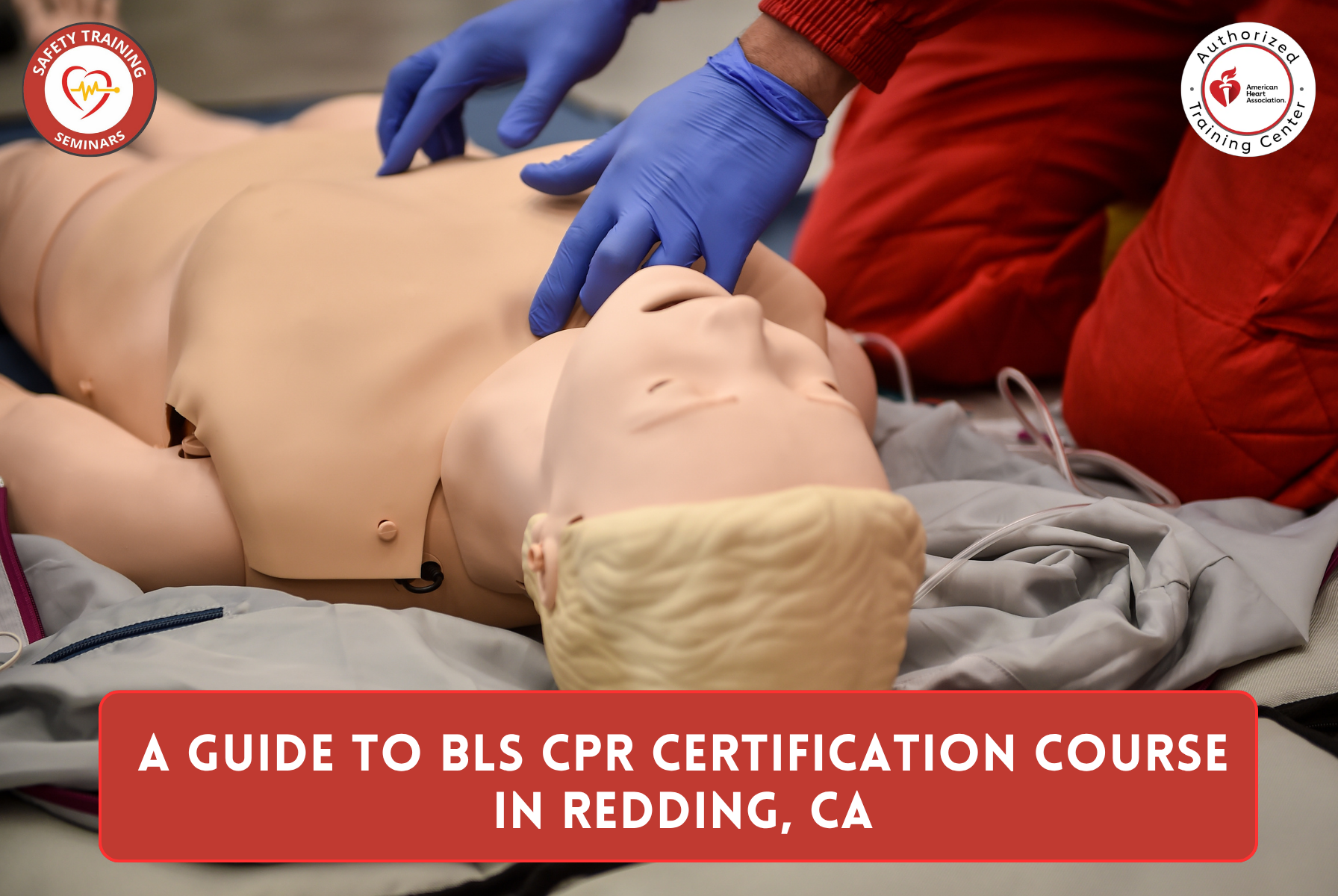
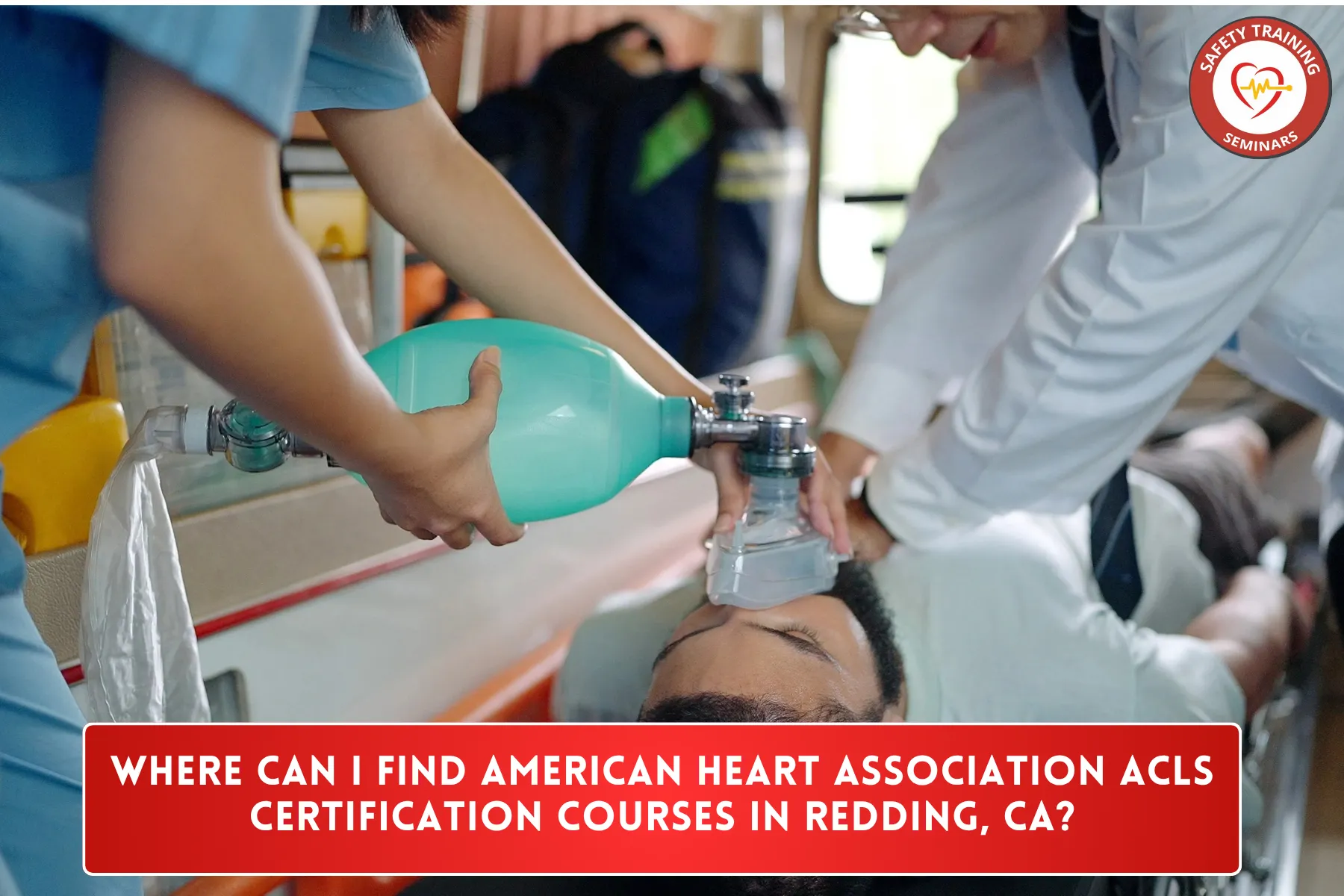
Safety Training Seminars offers an ACLS class in Redding at its downtown training center on Pine Street, a short drive from Interstate 5 and Highway 44. The ACLS certification course in Redding follows a blended American Heart Association (AHA) format. You complete the cognitive portion online, then finish hands-on skills verification at the center’s CPR Verification Station™ learning center. Students who pass both parts receive an AHA Course Completion eCard.
Redding is the main healthcare hub for a large part of far Northern California, so clinicians drive in from Anderson, Shasta Lake, Red Bluff, and smaller mountain towns to train here. The sections below cover what ACLS includes, why it matters in a regional referral market like Redding, and how to choose the right learning pathway.
ACLS in Plain Terms
Advanced Cardiovascular Life Support (ACLS) is an American Heart Association course that teaches healthcare providers how to manage adult cardiac arrest and other cardiovascular emergencies. BLS covers the foundation: compressions, ventilation, and AED use. ACLS adds clinical decisions on top of that foundation, such as reading a rhythm strip, choosing a medication, deciding when to shock, and coordinating a resuscitation team.
The AHA ACLS course typically covers:
- High-quality CPR and early defibrillation
- Recognition of shockable and non-shockable cardiac arrest rhythms
- Bradycardia and tachycardia algorithms
- Airway management and resuscitation medications
- Recognition and early management of acute coronary syndromes
- Suspected stroke assessment
- Post-cardiac arrest care
- Team roles, closed-loop communication, and code leadership
ACLS is designed for people with clinical training. Learners should be comfortable with BLS skills before they begin.
Why ACLS Matters in Redding’s Regional Healthcare System
Redding’s healthcare role is larger than its population suggests. Mercy Medical Center Redding serves as a regional referral hospital for far Northern California, an area covering roughly a quarter of the state’s land. Mercy Redding operates a Level II Trauma Center, a Level III NICU, and stroke and cardiovascular services. It is also one of only two Level II trauma centers north of Sacramento.
That regional role affects how local clinicians use ACLS:
- Cardiac and stroke patients arrive from long distances. Teams in emergency, cath lab, ICU, and telemetry units often receive patients transferred from smaller hospitals.
- Transport times are long. Paramedics and transport nurses may manage an unstable patient for an extended period before reaching definitive care, so knowing rhythm management and post-arrest care well matters.
- Rural facilities have fewer staff. Clinicians at smaller hospitals and clinics in the region may be the only advanced providers present during a code.
Shasta Regional Medical Center is another major acute care hospital in Redding. Staff in its emergency and critical care departments are among the local clinicians who commonly need ACLS. Requirements differ by role, so always confirm with your own department.
Healthcare Students and New Graduates in Shasta County
Redding is also a training ground for future clinicians. Mercy Medical Center Redding serves as a clinical training site for nursing students, pharmacy students, and a family medicine residency. Two local schools feed the regional workforce:
- Simpson University offers a BSN program in Redding.
- Shasta College offers health programs that include registered nursing and EMT/paramedic training.
Students usually need BLS before clinical rotations. ACLS requirements vary much more. Paramedic programs often include ACLS, and some new-graduate RN residencies in emergency or critical care require it within a set period after hire. Others do not. Check your program handbook or offer letter before you register so you don’t pay for a course you don’t need yet.
Who Commonly Needs AHA ACLS in Redding?
ACLS is often required or recommended for:
- Emergency department, ICU, PCU, and telemetry nurses
- Cath lab, interventional radiology, and PACU staff
- Hospitalists, emergency physicians, and residents
- Nurse practitioners and physician assistants in acute or urgent care
- Paramedics, flight crews, and critical care transport teams
- Respiratory therapists
- CRNAs and anesthesia providers
- Dentists and oral surgeons who provide sedation, depending on permit rules
Some clinicians in outpatient, home health, or long-term care settings only need BLS. Your employer’s policy decides, not the job title.
Choosing Your ACLS Pathway at the Redding Center
The Redding center offers two blended AHA pathways for ACLS. Both combine online learning with in-person skills verification, and both lead to an AHA Course Completion eCard. This table compares them.
| Feature | Self-Guided Learning™ | HeartCode® Complete |
| Online portion | True Adaptive™ learning powered by Area9 Lyceum, which adjusts to your knowledge and confidence | AHA HeartCode® online modules with patient cases |
| Hands-on portion | Completed independently at the CPR Verification Station™ learning center with real-time feedback | Skills verification session at the training center |
| Good fit for | Experienced providers who want to move quickly through familiar material | Learners who prefer a structured, case-based online course |
| Result | AHA Course Completion eCard | AHA Course Completion eCard |
The training center estimates the online portion at about two to three hours and the skills session at about 30 minutes. Your actual time depends on how familiar you are with the material.
Initial Course or Renewal?
If you have never held an AHA ACLS card, or your card has lapsed, check whether your employer needs a full provider course. If you are renewing, schedule before the recommended renewal date printed on your card, which is two years after your course date. Many hospital scheduling systems flag expired cards and may restrict shifts until you renew.
Training Close to Home in the North State
Many clinicians in this region live far from where they work. A nurse at Mercy Redding may commute from Anderson or Cottonwood. A paramedic may cover routes toward Shasta Lake, Palo Cedro, or the Highway 299 corridor. Staff at St. Elizabeth Community Hospital in Red Bluff, about 30 miles south, sometimes prefer Redding’s larger selection of services and schedules.
A center near the junction of I-5 and Highway 44 is easy to reach from most directions. A blended course also means only one short trip into town instead of a full day away from work or family.
Safety Training Seminars in Redding
The Safety Training Seminars Redding CPR Training Center is located at 1135 Pine Street, Suite 207, Redding, CA 96001, near downtown Redding.
The center lists its hours as 8 a.m. to 10 p.m., seven days a week, which helps clinicians on rotating or night shifts schedule their skills check. In addition to ACLS, the location offers AHA BLS and PALS, AAP NRP, and CPR and First Aid courses. You can call (530) 763-6821 with questions.
Current session times, pricing, and pathway details are listed on the ACLS classes in Redding page.
Why Redding Clinicians Choose Safety Training Seminars
Safety Training Seminars points to several reasons healthcare workers in Shasta County train with them:
- Accessible downtown location near I-5 and Highway 44
- Flexible scheduling, with self-paced online learning and skills sessions seven days a week
- Frequent course availability for initial and renewal students
- Competitive pricing, backed by a Low Price Guarantee and price matching
- More than 100 offices across its network
- Over 39 years of experience in emergency care training
- AHA Course Completion eCard issued after successful skills verification
If you need BLS or PALS along with ACLS, the Safety Training Seminars Redding training center lists every course offered at the Pine Street location.
Before You Register: A Quick Checklist
- Confirm the exact course. Your employer may specifically require “AHA ACLS Provider.” Online-only courses without hands-on skills testing are not the same.
- Check your BLS card. If it expires around the same time, renewing both together saves a trip.
- Ask about blended learning. Most employers accept AHA blended courses, but confirm with your education department.
- Review ECG rhythms and medication doses. Both pathways go more smoothly when you know the algorithms.
- Look up current promotions on the registration page rather than relying on older ads.
Frequently Asked Questions About ACLS Classes in Redding
Is there an AHA ACLS course in downtown Redding?
Yes. Safety Training Seminars runs an AHA training center on Pine Street in downtown Redding. Students complete the online portion of ACLS first, then finish hands-on skills verification at the center. The center is easy to reach from I-5 and Highway 44 for students coming from Anderson, Shasta Lake, and Red Bluff.
Do nurses at Mercy Medical Center Redding need ACLS?
It depends on the unit. ACLS is commonly required for emergency, critical care, cardiac, and procedural nursing roles, while many other positions only require BLS. Mercy Redding sets its own requirements by department, so confirm with your manager or nursing education office before registering.
Should Shasta College or Simpson University students take ACLS?
Not always. Most nursing students need BLS for clinical rotations, but ACLS is usually required later, when you start working in acute care or join a paramedic program. Check your program handbook or new-graduate residency requirements before you book an ACLS course.
What is the difference between Self-Guided Learning™ and HeartCode® Complete?
Both are blended AHA pathways that lead to the same eCard. Self-Guided Learning™ uses True Adaptive™ technology that adjusts to what you already know, and you complete skills independently at the CPR Verification Station™. HeartCode® Complete uses AHA case-based online modules followed by a skills verification session.
How long is an ACLS card good for?
AHA ACLS cards carry a recommended renewal date two years after your course date. Many hospitals in Shasta County track these dates closely, so plan your renewal a few weeks in advance, especially if you work rotating shifts.
Can I take BLS and ACLS at the same visit?
Many students take both, because ACLS builds directly on BLS skills. Each course has its own online work and skills check. Contact the Redding center or check the registration page to see how to schedule both efficiently.
Final Thoughts
For clinicians in Shasta County and the wider North State, ACLS is often part of working in emergency, critical care, or transport roles. The Safety Training Seminars center on Pine Street offers two blended AHA pathways, extended daily hours, and an AHA eCard after successful skills verification.
Check your employer’s or program’s requirements, choose the pathway that fits how you learn, and schedule your skills session at the Redding center.