Redding stands apart from most Northern California cities in a way that its residents understand on a practical, daily level. As the largest city in Shasta County and the de facto hub of the Northern Sacramento Valley, Redding serves a regional healthcare catchment area that extends hundreds of miles in every direction — north toward the Oregon border, east into the rural mountain communities of Shasta and Trinity counties, and south along Interstate 5 toward Sacramento. The clinical professionals working here aren’t just serving a local population. They’re anchoring a regional medical system that hundreds of thousands of people across Northern California depend on when emergencies happen far from any major urban center. For those professionals — nurses at Mercy Medical Center Redding on Cypress Avenue, paramedics with the Redding Fire Department, respiratory therapists at Shasta Regional Medical Center — maintaining current BLS, ACLS, and PALS training isn’t a routine administrative task. It’s the professional foundation everything else rests on.
The public health picture in Shasta County makes that foundation more consequential, not less. Northern California communities face cardiac emergency response challenges that their Bay Area counterparts rarely encounter: greater distances between patients and advanced care, longer EMS response windows in rural areas, and a demographic profile that skews toward older adults with higher rates of cardiovascular risk. The American Heart Association reports that bystander CPR administered immediately after cardiac arrest can double or triple survival rates. In a regional hub like Redding — where neighborhoods like Buckeye, Stillwater, and the Cascade Boulevard corridor support a clinical workforce that serves as the backbone of emergency response across a vast geographic area — every current AHA card represents a meaningful extension of that survival window.
What many of Redding’s healthcare professionals are now examining more carefully is not simply whether to complete their BLS, ACLS, or PALS renewal, but which training format makes that process genuinely achievable given the realities of life and work in Northern California’s most important healthcare city. Two distinct pathways exist: traditional instructor-led classroom training and the increasingly adopted Self-Guided Learning™ model paired with CPR Verification Station™ learning centers. Both lead to successfully completing the course and receiving an AHA Course Completion eCard. This guide compares both formats directly so Redding’s clinical community can choose the path that actually fits their professional lives.
Overview of CPR Training Options in Redding
For healthcare professionals throughout Redding and surrounding Shasta County communities like Anderson, Shasta Lake City, and Red Bluff, two primary training formats are available for completing BLS, ACLS, and PALS requirements:
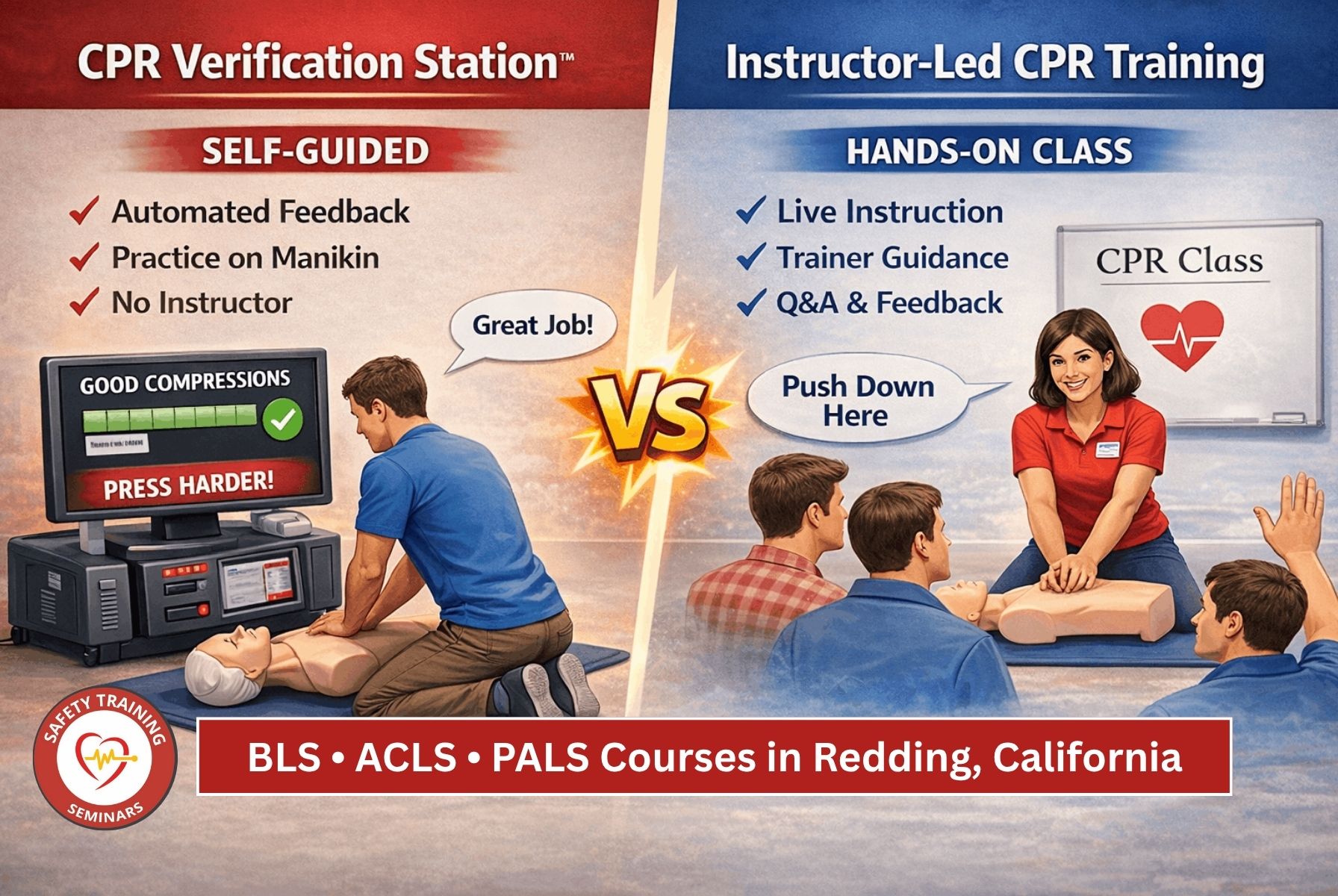
- Instructor-Led Training — A fixed-schedule, in-person classroom session facilitated by a course instructor, where both cognitive content and hands-on skills practice are delivered in a single multi-hour block, typically spanning four to eight hours depending on the program level.
- Self-Guided Learning™ + CPR Verification Stations — A flexible two-part model combining an adaptive online course completed independently on the learner’s own schedule with a focused, technology-evaluated skills session at a CPR Verification Station™ learning center.
Both pathways satisfy AHA requirements and produce an AHA Course Completion eCard upon successfully completing the course. The practical experience of reaching that outcome, however, differs meaningfully — and in a city as geographically isolated as Redding, those differences carry particular weight.
Traditional Instructor-Led CPR Training in Redding
Instructor-led training has served as the standard format for AHA BLS, ACLS, and PALS programs throughout Shasta County for many years. In this model, participants arrive at a scheduled training facility, join a group of fellow learners, and work through AHA-approved curriculum content under the direct guidance of a course instructor. The session flows from video instruction and live technique demonstration into hands-on skill stations covering chest compressions, airway management, defibrillation protocols, and increasingly complex scenario-based resuscitation exercises appropriate to the course level.
For clinical departments at Mercy Medical Center Redding or Shasta Regional Medical Center whose employers coordinate on-site group sessions, this format has historically provided a workable structure when institutional logistics handle the scheduling. Healthcare workers commuting between Redding and outlying Shasta County communities have also accessed employer-organized classroom sessions when departmental arrangements align. The complications begin when individual professionals must independently locate, register for, and attend a session that actually fits their availability in a city where training infrastructure is more limited than in major metropolitan areas.
How Instructor-Led Training Works
A standard BLS class in Redding’s instructor-led format runs between two and a half and four hours. ACLS courses extend significantly — often to six or eight hours — covering advanced cardiac rhythm interpretation, pharmacological protocols, complex airway management strategies, and multi-role team resuscitation scenarios requiring extended hands-on practice at multiple skill stations. PALS programs follow a comparable timeline through a pediatric lens, with age-specific clinical frameworks demanding careful, unhurried attention throughout.
The course instructor observes participant technique, provides real-time verbal guidance, and confirms that AHA performance standards have been met before signing off. When all components are cleared, learners successfully complete the course and receive their AHA Course Completion eCard. For participants encountering advanced material for the first time, the live instructor presence can provide guidance and contextual explanation that genuinely supports learning during complex clinical scenarios.
Limitations of Instructor-Led Classes
Redding’s geographic position as Northern California’s primary regional hub creates a unique set of limitations for the instructor-led format that healthcare professionals in more densely populated areas rarely face. Training options are fewer. Sessions fill faster. And when a particular ACLS or PALS session books out, the next available one may be weeks away — with no nearby alternative in Chico or Sacramento that doesn’t require a 160-mile round trip on I-5.
For a clinical worker in the Buckeye neighborhood finishing a night shift at Mercy Medical Center, the prospect of sitting through a six-hour ACLS program the following morning isn’t just fatiguing — it’s a genuine patient safety concern. Cognitive performance during complex scenario-based training directly after an overnight clinical rotation is not optimal under any reasonable assessment. Add the commute, the parking, and the mental overhead of coordinating childcare or family logistics in a community where dual-income households are the norm, and the true cost of a single instructor-led classroom day becomes substantial.
Schedule availability compounds everything. Shasta County doesn’t have the density of training providers that the Bay Area or Sacramento metro offers. When sessions fill at local providers near Shasta Regional Medical Center or Mercy Medical Center Redding, alternatives are limited. A nurse in the Stillwater area or a paramedic based near the Redding Municipal Airport whose renewal deadline is six weeks out may genuinely have no viable instructor-led option available without significant logistical sacrifice.
The Rise of CPR Verification Stations in Redding
Across Shasta County and the broader Northern California healthcare corridor, the mismatch between the traditional classroom model and the scheduling realities of a regional medical hub like Redding has driven meaningful adoption of more flexible, technology-supported training alternatives. CPR Verification Stations represent one of the most significant practical advances in that evolution — shifting the skills verification process away from the group-paced, observer-dependent classroom setting toward a learner-controlled, objectively measured system designed for how today’s clinical professionals actually operate.
Training providers serving the Redding area have recognized that scheduling rigidity and limited local session availability in the traditional model create compliance delays that the regional workforce can’t afford — and have responded by incorporating CPR Verification Station-based evaluation as a core program component. For a healthcare hub serving a vast and geographically diverse region, that response carries particular strategic importance.
What Is a CPR Verification Station?
A CPR Verification Station™ learning center is a precision technology system built around sensor-equipped manikins that capture real-time, granular performance data throughout a CPR skills evaluation. Compression depth, rate, hand placement accuracy, full chest recoil between compressions, and the timing and volume of each ventilation are all measured continuously and assessed automatically against current AHA performance standards. The result is immediate, objective feedback that doesn’t vary based on who is observing, how large the session is, or any factor external to the learner’s own demonstrated technique.
For Redding’s clinical professionals — many of whom work in environments where consistent, documented performance standards govern every aspect of patient care delivery — a skills evaluation system built on those same principles of objective, data-driven measurement carries natural professional credibility. The assessment is the same every time. The AHA standard is applied uniformly. What the sensors capture is what matters.
How Self-Guided BLS, ACLS, and PALS Courses Work
The online knowledge component of the Self-Guided Learning™ model is delivered through the HeartCode® Complete course — the AHA’s approved digital curriculum covering BLS, ACLS, and PALS programs in full. What distinguishes HeartCode® from a conventional online training video is the responsive, intelligent system driving its content delivery: True Adaptive™ learning powered by Area9 Lyceum.
This platform continuously monitors how each participant engages with course content and adjusts the learning experience in real time based on demonstrated understanding. An experienced emergency department nurse from Redding’s Cascade Boulevard area renewing her ACLS program doesn’t sit through foundational cardiac rhythm content she has applied clinically for nearly a decade — True Adaptive™ learning powered by Area9 Lyceum identifies her existing competency with that material and advances accordingly, directing review and reinforcement to the content areas where genuine gaps exist. For a newer paramedic working through the PALS program for the first time, the platform responds entirely differently — slowing down at challenging pediatric assessment frameworks, revisiting difficult concepts, and confirming comprehension at each stage before progressing.
Once HeartCode® Complete is finished, the participant schedules a brief, focused skills session at a nearby CPR Verification Station™ location. The hands-on evaluation is time-efficient, targeted, and produces an objective performance record against AHA standards. The AHA Course Completion eCard follows.
Key Advantages of CPR Verification Stations
For healthcare professionals across Redding and surrounding Shasta County communities including Anderson, Shasta Lake City, and Red Bluff, the practical advantages of this model are concrete and immediately applicable to working clinical life:
- Complete scheduling freedom — The HeartCode® Complete online course can be started, paused, and completed at any time — late evenings after shifts, weekend mornings along the Sacramento River trail corridor, or distributed across multiple sessions over a week or more.
- Genuine time efficiency — True Adaptive™ learning powered by Area9 Lyceum removes redundant review for experienced clinicians, cutting total course time meaningfully compared to the uniform pace of a full-day classroom program.
- Objective, consistent evaluation — CPR Verification Station™ technology applies standardized AHA performance criteria uniformly, eliminating the natural variability of human observation across different sessions and instructors.
- Regionally accessible — Shorter, more flexibly scheduled skills sessions are far easier to book around a Redding professional’s actual weekly calendar than a blocked full-day classroom commitment with limited local session options.
Why Healthcare Professionals in Redding Prefer Self-Guided Learning
The neighborhoods of Buckeye and Stillwater, and the communities stretching along Shasta Dam Boulevard and Hartnell Avenue, are home to a clinical workforce that operates under pressures that urban healthcare professionals rarely encounter with the same intensity. Redding’s medical facilities don’t just serve a local city. They serve as referral destinations for a huge geographic region, which means clinical teams at Mercy Medical Center Redding and Shasta Regional Medical Center regularly manage patient complexity and acuity that might surprise professionals accustomed to more metropolitan settings. Those demands don’t leave a lot of margin for the kind of scheduling flexibility that instructor-led classroom training requires.
Self-Guided Learning™ courses give that margin back. A respiratory therapist rotating through Shasta Regional Medical Center’s ICU can complete the ACLS course online during several evenings at home, then book a focused skills session at a nearby CPR Verification Station™ location when his week allows — not when a classroom calendar has an opening in a city where classroom options are limited to begin with. A home health nurse serving the Cascade Homes area and surrounding rural communities can complete the BLS program across several sessions spread over two weeks, then handle the hands-on verification component at a time that genuinely fits. That flexibility isn’t a compromise in training quality. In a regional hub like Redding, it’s the difference between staying current and falling behind.
Instructor-Led vs. CPR Verification Stations: Side-by-Side Comparison
Examining both formats side by side, the fundamental difference is one of design orientation. Instructor-led training is organized around the delivery event — a fixed date, a fixed location, and a shared pace that applies uniformly to every participant regardless of their clinical background, experience level, or how much of the material they already know. That standardization can support learning in the right context, particularly for participants new to complex clinical scenarios. For most working healthcare professionals in a geographically isolated regional hub like Redding — where training options are fewer, schedules are demanding, and alternatives to a booked session may not exist locally — it creates structural obstacles that the workforce simply shouldn’t have to navigate.
Self-Guided Learning™ with CPR Verification Stations is structured entirely around the individual learner. HeartCode® Complete adapts to demonstrated knowledge through True Adaptive™ intelligence, ensuring every portion of the online course adds genuine value. The CPR Verification Station™ skills session is brief, bookable on a flexible timeline, and evaluated by technology that applies the same consistent AHA standard every time. On flexibility, time investment, scheduling control, and evaluation consistency — the dimensions that matter most in a community like Redding — the Self-Guided Learning™ model holds a decisive and practical advantage.
Which Option Is Better for You in Redding?
Instructor-led training is the right fit if you’re completing an ACLS or PALS program for the very first time and benefit from the structure of a live, group-based learning environment with a course instructor physically present. Some participants — particularly those encountering multi-role resuscitation scenarios or pediatric emergency protocols for the first time — find that real-time technique demonstration and immediate verbal feedback builds foundational confidence that’s harder to develop independently. If the material is genuinely new and session availability aligns with your schedule, the classroom format offers real learning value.
Self-Guided Learning™ is the stronger choice if you’re renewing familiar coursework, your schedule rotates or shifts unpredictably, or you simply need an efficient path to completing your BLS class in Redding, wrapping up your ACLS program before a deadline, or finishing your PALS course without surrendering a full day off to a training system with limited local session options. For most experienced clinical professionals managing the demands of Northern California’s most active regional medical hub, this is the format that was designed around how they actually work.
Local Demand for CPR BLS, ACLS, and PALS Training in Redding
The clinical renewal pipeline across Shasta County is active and substantial year-round. Mercy Medical Center Redding on Cypress Avenue and Shasta Regional Medical Center on Arbuckle Drive are the two primary acute care facilities serving the immediate Redding community, together employing a large combined clinical workforce with active AHA renewal requirements. Patients Progress Hospital and the Vibra Hospital of Northern California add further volume to the local clinical employment base. Professionals also travel periodically to Enloe Medical Center in Chico or UC Davis Medical Center in Sacramento for specialized services — extending the renewal demand across a broad geographic area.
The Redding Fire Department contributes its own substantial contingent of emergency responders to the local AHA training renewal pool, given Redding’s role as the regional hub for emergency services across Shasta County. With two-year renewal cycles running continuously across all of these organizations and a regional population that remains geographically dispersed across one of California’s largest county footprints, the demand for accessible CPR training near Redding is consistent and significant throughout the calendar year. The shift toward flexible, technology-supported training formats reflects a workforce that has clearly outgrown the scheduling assumptions of a model designed for denser urban training markets.
How Safety Training Seminars Supports Modern CPR Training
Safety Training Seminars serves healthcare professionals across Redding, Anderson, Shasta Lake City, Red Bluff, and the broader Northern California region by offering both instructor-led options and the Self-Guided Learning™ model backed by CPR Verification Station™ learning centers — ensuring every participant has a training pathway that aligns with their actual schedule and their level of clinical experience.
Available programs include BLS, ACLS, PALS, NRP, and First Aid, covering the complete range of AHA training needs across clinical and non-clinical roles. The combination of quality curriculum, genuine scheduling flexibility, and accessible skills verification makes Safety Training Seminars a trusted resource for healthcare teams serving Shasta County’s regional medical system — a provider that understands the unique demands facing clinical professionals in communities where training infrastructure and geographic isolation intersect in ways that standard urban models simply don’t address.
The Future of CPR Training in Redding
For a regional medical hub like Redding, the trajectory of healthcare training innovation carries particular urgency. Personalized, technology-integrated learning experiences that adapt to individual learners and respect the realities of complex clinical schedules are progressively replacing the one-size-fits-all classroom model — and for a community where training session scarcity has long been a practical constraint, that shift represents a genuinely meaningful improvement. True Adaptive™ learning powered by Area9 Lyceum and CPR Verification Stations are at the forefront of that change, and the healthcare organizations in Shasta County that have already embraced these tools are seeing measurable improvements in compliance rates, training efficiency, and the overall sustainability of their renewal programs.
For Redding’s clinical professionals, this isn’t an abstract industry trend. It’s a practical option available today — and the community’s most forward-thinking healthcare workers are already using it to stay current without disrupting the clinical work that Northern California depends on them to deliver.
Start Your BLS, ACLS, or PALS Course in Redding Today
Whether you’re pursuing a BLS course in Redding for the first time or renewing your ACLS program before a compliance deadline arrives, a training pathway designed for your schedule and your professional context is available right now. Healthcare professionals across Shasta County — from Buckeye to Stillwater, from Anderson to Red Bluff — are already completing their programs through the Self-Guided Learning™ model, receiving their AHA Course Completion eCard, and returning to their clinical roles without the disruption of a mandatory full-day classroom commitment in a city where that kind of commitment carries a particularly high logistical cost.
Don’t let a booked-out session or a stretch of consecutive shifts push your renewal into non-compliance. Choose the format that fits your life, complete your BLS, ACLS, or ACLS training in Redding on your own terms, and stay current with the skills that Northern California’s patients depend on you to carry.